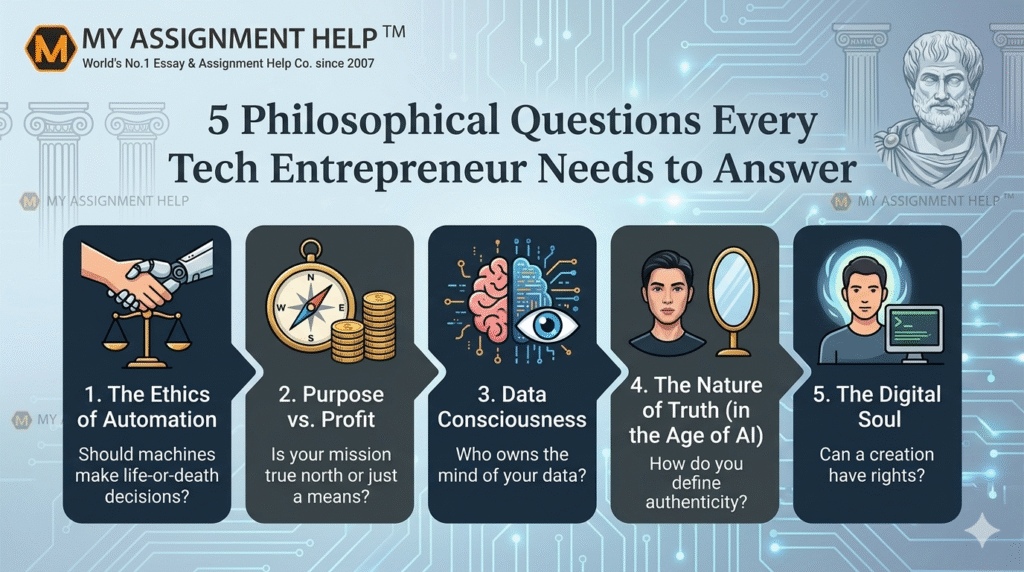
In the hyper-accelerated world of Silicon Valley and global tech hubs, the “move fast and break things” ethos has long been the gold standard. However, as we enter the era of Generative AI, neurotechnology, and autonomous systems, the stakes of “breaking things” have shifted from minor software bugs to fundamental societal shifts.
Today’s tech entrepreneur cannot afford to be just a coder or a financier; they must be a practical philosopher. The most successful founders—from Steve Jobs to Sam Altman—have succeeded not just through superior tech, but by answering deep questions about human nature and ethics.
Before you scale your next SaaS platform or launch a disruptive AI model, you must confront the metaphysical foundations of your venture. Here are the five philosophical questions that will define your leadership and your legacy.
1. The Ontological Question: Are You Solving a Problem or Altering Human Nature?
Every pitch deck claims to “solve a pain point.” But at a deeper level, technology often rewires how we exist. When social media “solved” long-distance communication, it simultaneously altered the human attention span and the nature of friendship.
As an entrepreneur, you must ask: Is my product helping humans flourish in their natural state, or is it fundamentally changing what it means to be human? This is a question of ontology—the study of being. If your tech encourages dependency or replaces human agency with algorithmic determinism, you are not just a service provider; you are an architect of a new human condition.
For those diving deep into these academic waters, understanding the lineage of these thoughts is vital. Students and researchers often seek philosophy assignment help to navigate the complex intersection of Heideggerian technology theory and modern digital ethics, ensuring their conceptual frameworks are as robust as their code.
2. The Teleological Question: What is the “End Goal” of Progress?
Teleology is the study of purpose or design. In tech, we often treat “innovation” as an inherent good. But innovation without a telos (an end goal) is merely motion without direction.
If your goal is purely “disruption,” you must answer: To what end? If you disrupt the taxi industry or the hospitality sector, what is the final state of the world you are creating? A world of total efficiency? A world of total surveillance? A world of radical decentralization? Without a clear philosophical North Star, your company will eventually succumb to “mission drift,” where profit becomes the only metric, often at the cost of the user’s well-being.
3. The Epistemological Question: Who Owns the Truth in an Algorithmic World?
Epistemology is the study of knowledge—how we know what we know. In the age of Big Data and AI, entrepreneurs are the new gatekeepers of truth. Your algorithms decide what news people see, what products they buy, and even who they date.
The philosophical burden here is immense. If your platform prioritizes engagement over accuracy, you are making an epistemological choice. You are stating that “popularity” is a higher value than “truth.” Entrepreneurs must decide early on: What is my responsibility to the integrity of information? As AI continues to hallucinate and deepfakes proliferate, the founders who build “trust-engines” rather than just “search-engines” will be the ones who survive the upcoming “crisis of reality.”
4. The Ethical Question: Does Your “Minimum Viable Product” Include a “Minimum Viable Ethics”?
The lean startup methodology encourages releasing products early to test the market. But when your product handles sensitive personal data or influences mental health, “testing” becomes an ethical minefield.
Ethical debt is much harder to pay down than technical debt. Whether it’s data privacy, algorithmic bias, or the environmental impact of GPU clusters, you must define your “red lines.” Will you sell user data to third parties? Will you allow your tech to be used for state surveillance? Answering these questions requires a firm grasp of Deontology (duty-based ethics) and Utilitarianism (consequence-based ethics).
Building a business while maintaining high academic and ethical standards is a heavy lift. Often, entrepreneurs-in-the-making find themselves overwhelmed by the rigors of business school and technical certifications. In such cases, seeking professional assignment writing help can provide the necessary support to balance rigorous theoretical study with practical application, ensuring that neither your education nor your venture suffers.
5. The Existential Question: If Your Company Succeeds Perfectly, Is the World Actually Better?
This is the ultimate “Mirror Test.” Imagine a world where your company has 100% market share. Every person on earth uses your app eight hours a day. Is the world more connected, or more isolated? Is wealth more distributed, or more concentrated? Is the human spirit more liberated, or more shackled to a screen?
If the honest answer to a “perfect success” scenario is a dystopian one, you are building on a hollow foundation.
See also: How Comprehensive Steam & Gas Turbine Field Services Reduce Outage Duration and Cost
The Entrepreneur’s Philosophical Toolkit (Infographic Logic)
Key Takeaways
- Move Beyond Logic: Technical logic builds the product; philosophical logic builds the brand and its impact.
- Ethics as a Feature: Don’t treat ethics as a legal compliance hurdle; treat it as a core product feature that builds user trust.
- The Power of Telos: A clear “Why” (purpose) is more sustainable than a clear “How” (technology).
- Academic Rigor: Understanding the history of thought helps prevent repeating the societal mistakes of past industrial revolutions.
Frequently Asked Questions (FAQ)
Q1: Why does a tech founder need philosophy?
A: Technology is no longer neutral. It shapes behavior, politics, and psychology. Philosophy provides the framework to navigate these impacts responsibly.
Q2: How can I implement “Minimum Viable Ethics” in my startup?
A: Start by creating an “Ethics Charter” during the seed stage. Define what you will never do with user data or AI training, regardless of profit potential.
Q3: Does focusing on philosophy slow down innovation?
A: It may slow down the release of a product, but it prevents catastrophic brand failure and regulatory legal battles in the long run.
Q4: Where can I learn more about the ethics of AI and Tech?
A: Studying “Digital Humanities” or “Philosophy of Technology” is a great start. Many founders use academic resources and specialized writing services to help synthesize these complex topics into their business models.
Author Bio
Dr. Aris Thorne is a Senior Consultant and Research Specialist at MyAssignmentHelp. With a Ph.D. in Applied Ethics and over a decade of experience in academic consulting, Dr. Thorne focuses on the intersection of emerging technologies and classical philosophy. He has helped thousands of students and aspiring entrepreneurs bridge the gap between complex theoretical frameworks and real-world application. When not auditing AI ethics, he contributes to journals on the future of digital education.
References & Data Sources:
- World Economic Forum (2023): Report on the “Global Risks of AI and Misinformation.”
- Stanford Encyclopedia of Philosophy: Entries on “Philosophy of Technology” and “Ethics of Artificial Intelligence.”
- Harvard Business Review (2022): “Why Every Startup Needs a Chief Philosophy Officer.”
- Pew Research Center: Data on digital trust and consumer privacy expectations (2024)